Career Alternatives for Project Coordinators: Next-Step Roles
Looking to take the next step in your career? Your project coordination skills open doors to diverse opportunities—from becoming a project manager or business analyst to exploring roles in HR, marketing, or even entrepreneurship. Explore these 10 career alternatives designed for your skill set.
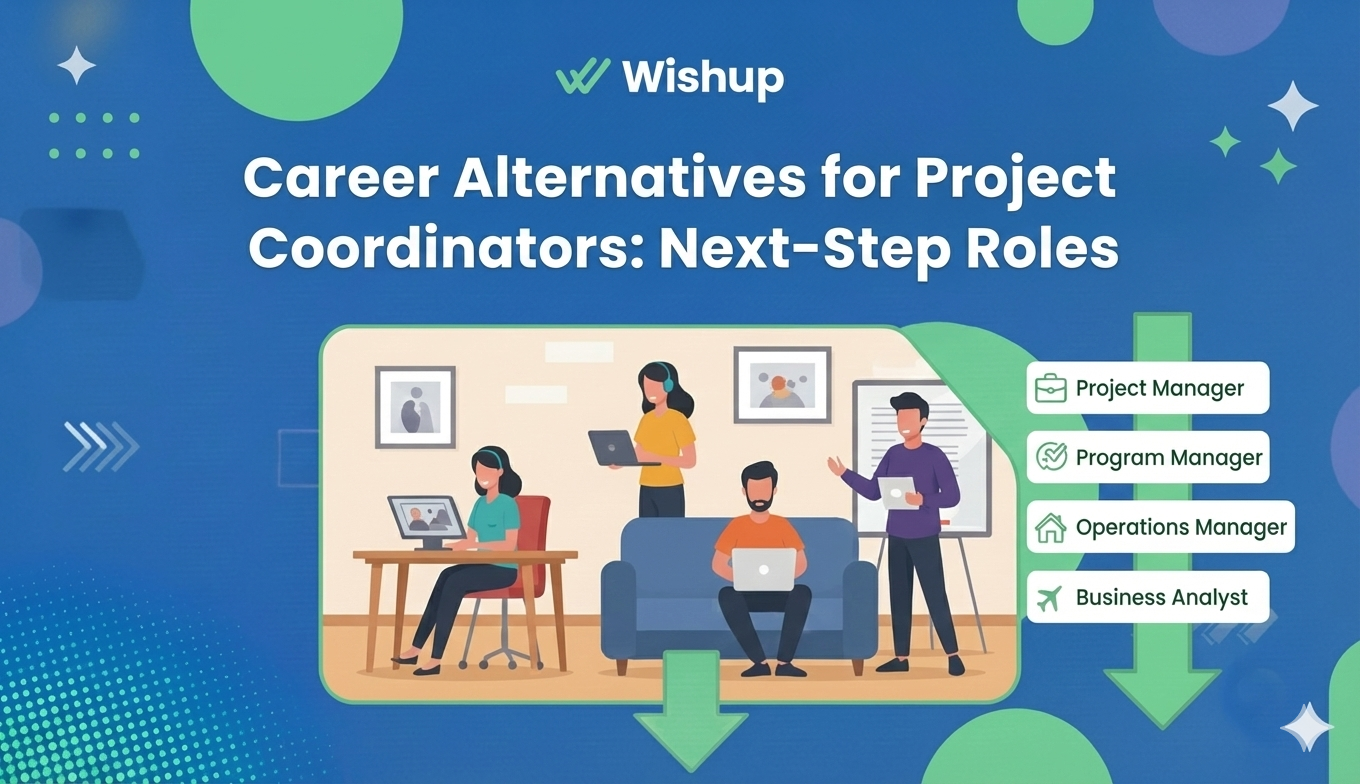
Project Manager Career Path Guide
Project coordinators sit at the centre of how work actually gets done. You schedule, communicate, document, manage stakeholders, follow up on the details and keep projects moving. It is some of the most transferable work in any business.
At some point many coordinators want a clear next step: more ownership, a leadership track, deeper specialisation, or a remote, work-from-home career that still rewards what they are best at. The good news is that your coordination skills open more doors than most people realise.
This guide walks through ten career alternatives for project coordinators, with the skills that transfer, the steps to get started, and where each path can lead.
A quick note on project coordinator vs project manager
The most common next move is from project coordinator to project manager, but it is far from the only option. Project managers tend to own scope, budget, risk, and stakeholder alignment end-to-end, whereas coordinators are more execution-focused. If you would rather move sideways into analysis, operations, people, or remote work instead of straight up the PM ladder, the roles below give you a fuller set of choices.
1. Virtual Assistant (VA)
Why It’s a Good Fit for Project Coordinators:
If you want flexibility or remote, work-from-home roles, virtual assistant and remote operations work is a strong fit. Your ability to organise tasks, manage schedules, communicate clearly, and keep stakeholders aligned transfers directly. Many professionals on this path are effectively doing project coordination work for global teams, just remotely.
Typical responsibilities include scheduling and calendar management, email and stakeholder coordination, task tracking and follow-ups, and client communication.
How to get started
- Identify the coordination-heavy tasks you excel at and build a one-page summary of them.
- Apply to structured, remote-first companies that train and place virtual assistants, including Wishup.
- Build a small portfolio of past coordination work, SOPs, or process documents you can share.
Career growth Senior VAs often progress into executive assistant, operations partner, or chief-of-staff style roles, sometimes commanding premium rates and working with founders directly.

Leverage your project coordination skills in new roles. Find out which careers; from event manager to entrepreneur are perfect for you.
2. Project Manager (PM)
Why It’s a Good Fit:
Project coordinators and project managers have similar roles, but project managers generally take on more responsibility. If you enjoy overseeing the entire project process, including budgeting, team coordination, and risk management, the transition to Project Manager (PM) is a natural one. As a PM, you will be responsible for handling large-scale projects, ensuring that they are completed on time and within budget.
How to Get Started:
- Certification: While certification is not mandatory, obtaining a Project Management Professional (PMP) certification will increase your job prospects and enhance your skills.
- Gain More Responsibility: Start by taking on larger projects or volunteer to lead teams in your current role to gain experience in managing projects end-to-end.
- Learn Tools: Familiarize yourself with tools like Microsoft Project, Trello, or Asana to manage tasks, timelines, and team communications.
Potential Career Growth and Benefits: Project management offers strong career growth and lucrative salaries. As you gain experience, you can advance to senior roles like Program Manager or Portfolio Manager, which involve overseeing multiple projects or entire departments.
3. Operations Manager
Why it's a good fit for project coordinators?
Coordinators already think in resources, timelines, and dependencies. If you enjoy improving efficiency and optimising workflows, operations management lets you do that across the business rather than per project.
How to get started
- Learn the basics of process design, supply chain, and resource planning.
- Look for opportunities to lead a small team or own a process improvement at work.
- Connect with operations managers in your network and ask how they made the move.
Career growth Operations roles can progress to Director of Operations, VP Operations, and ultimately Chief Operating Officer, with strong demand across industries.
4. Event Manager
Why it's a good fit for project coordinators?
Event work is project coordination in a different setting: timelines, vendors, logistics, and a hard deadline. If you enjoy the logistics side of your role, this is a clean transition.
How to get started
- Volunteer to help organise events at work or in your community.
- Take a short event management or hospitality course to learn the language of the industry.
- Build a small portfolio with a few real events: a workshop, a conference, even a wedding.
Career growth You can progress to Senior Event Manager or Event Director, move into corporate events, weddings, or festivals, or set up your own event planning business.
5. Business Analyst
Why it's a good fit for project coordinators?
Business analysis plays to the analytical side of project work. You gather requirements, study customer or user needs, analyse data, and help stakeholders make informed decisions. It is a good fit for coordinators who would rather think and analyse than chase execution.
How to get started
- Get comfortable with Excel and a BI tool like Power BI or Tableau.
- Take an IIBA, ECBA, or CBAP-aligned course or certification.
- Practise translating real business problems into structured requirement documents.
Career growth Business analysts can progress to Senior Business Analyst, Business Intelligence Analyst, or Product Manager. Demand is consistently strong across IT, SaaS, and BFSI.
6. Human Resources (HR) Specialist
Why it's a good fit for project coordinators?
Coordinators work closely with teams and naturally pick up an eye for how people work. If you enjoy that side more than the timelines, HR can be a rewarding pivot into recruitment, employee experience, and people operations.
How to get started
- Take an HR fundamentals course covering recruitment, employee relations, and labour basics.
- Pursue a credible certification such as SHRM-CP or PHR.
- Speak to HR professionals to understand what each specialism actually involves day to day.
Career growth HR roles progress to HR Business Partner, HR Manager, HR Director, and eventually CHRO, with strong cross-industry demand.
7. Supply Chain Manager
Why It’s a Good Fit?
If you have ever managed vendors, inventory, or logistics within a project, supply chain is a natural extension. You will oversee the movement of goods and services so they arrive on time and at the right cost.
How to get started
- Take a course in logistics, procurement, or inventory management.
- Volunteer to manage supplier relationships or run a procurement task in your current role.
- Build analytical skills, especially around demand forecasting and process optimisation.
Career growth Supply chain professionals can progress to Supply Chain Director and Chief Supply Chain Officer, with very strong global demand.
8. Consultant
Why It’s a Good Fit?
Years of running projects give you a sharp instinct for what slows businesses down. If you enjoy diagnosing problems and recommending fixes, consulting lets you do that across multiple companies and industries.
How to get started
- Pick a niche where you genuinely have depth, for example project recovery, process design, or PMO setup.
- Build a network of past colleagues and prospects who can refer or hire you.
- Start with small freelance engagements to build case studies and confidence.
Career growth Consulting offers strong income potential, flexibility, and the option to scale from solo practice to a small consultancy over time.
9. Entrepreneur
Why It’s a Good Fit?
Running a business is, in many ways, running a never-ending project. Your coordination, planning, and stakeholder skills are exactly what early-stage businesses need most.
How to get started
- Identify a real problem you understand well and validate it with potential customers.
- Write a short, practical business plan covering offer, customers, costs, and timelines.
- Start as a side venture while you still have an income, and grow from there.
Career growth Entrepreneurship offers unlimited upside but real risk. Many coordinators start with consulting, agency, or service-based businesses before scaling further.
10. Marketing Manager
Why it's a good fit for project coordinators?
Marketing is highly coordinated work: campaigns, briefs, agencies, designers, deadlines, and outcomes. If you enjoy planning, coordinating across teams, and turning briefs into measurable results, marketing management is a strong fit.
How to get started
- Take a marketing fundamentals course covering positioning, brand, content, and digital channels.
- Coordinate a marketing campaign or event at work to get hands-on exposure.
- Get comfortable with the working tools: Google Analytics, a CRM, an email tool, and a project management tool.
Career growth Marketing managers can specialise into digital, brand, content, or growth, and progress to Senior Marketing Manager, Head of Marketing, and Chief Marketing Officer.
Choosing the Right Project Manager Career Path
Before making a switch, pause and ask:
- Do I want stability or flexibility?
- Am I actively looking for work-from-home project coordinator jobs?
- Do I enjoy strategy more than execution?
- Do I prefer working with systems, people, or customers?
The most useful next move is rarely the most obvious one. The aim is a role that builds on what you are already good at and takes you toward the work you actually want to do.
Conclusion
Project coordinators carry some of the most valuable skills in modern business: planning, communication, follow-through, and the ability to make complex things land on time. Those skills travel well, into project management, operations, analysis, HR, supply chain, consulting, entrepreneurship, marketing, and the remote-first careers that have grown so quickly in the last few years.
Pick the path that fits your strengths and the working life you want, and your coordinator background becomes a real advantage, not a step you are trying to leave behind. If a remote, ownership-style next move appeals, the virtual assistant and remote operations route is one of the quickest to step into.